Alan Dexter
Sugarbeet Weed Control Specialist
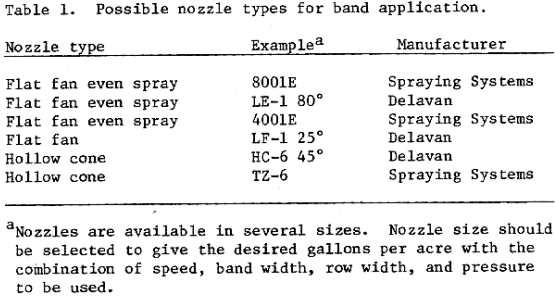
The designation on the teejet nozzles has a specific meaning. The first two numbers indicate the spray angle. An 8001 nozzle has an 80 degree spray angle at 40 psi. The second two numbers indicate the capacity of the nozzle. An 8001 nozzle would deliver 0.1 gallons per minute (gpm) of water at 40 pounds per square inch pressure (psi). The E following the numbers means that the nozzle is an even spray nozzle and can be used for banding. The Delavan nozzle that is equivalent to the 8001E Teejet nozzle is the LE-1 80°. The LE-1 80° is an even spray nozzle with 0.1 8 pm capacity and 80° spray angle at 40 psi. The Delavan LF-1 25° listed in the table is a flat spray nozzle and flat spray nozzles should not normally be used for banding. However, when the spray angle of a Delavan nozzle is as narrow as 25 degrees, then the spray pattern approaches an even spray nozzle and therefore can be used for banding. The narrow angle nozzles must be positioned quite high for a 5 inch band and the spray particles would be more susceptible to drift. The Spraying Systems TZ and the Delavan HC nozzles are hollow cone nozzles. The HC-6 45° and the TZ-6 nozzles will deliver 6 gallons per hour (gph). The HC-6 45° nozzle has a 45° spray angle and the TZ-6 has a 50° spray angle at 40 psi. Please note that the number on the hollow cone nozzles indicate gallons per hour and the number on the flat fan nozzles indicate gallons per minute. Thus the HC-6 and TZ-6 nozzles have the same delivery as the 8001E, LE-1 80°, or 4001E nozzles.
Spraying Systems recently developed a narrow angle flat fan even spray nozzle for band application. The example in the table is the 4001E. This nozzle has a 40° spray angle and delivers 0.1 8pm at 40 psi.
Hollow cone nozzles in a vertical position can be used for band application because they produce a spray pattern that is fairly uniform from edge to edge. However, when a hollow cone nozzle is angled from vertical, the spray pattern becomes heavy in the center and light at the edges. Hollow cone nozzles should not be used in the double nozzle band sprayers since two hollow cone nozzles turned at a 45° angle from vertical produce a spray pattern which is not uniform from edge to edge. Two angled flat fan band application nozzles (Table 1) produce a more uniform pattern than two angled hollow cone nozzles in the double nozzle sprayers.
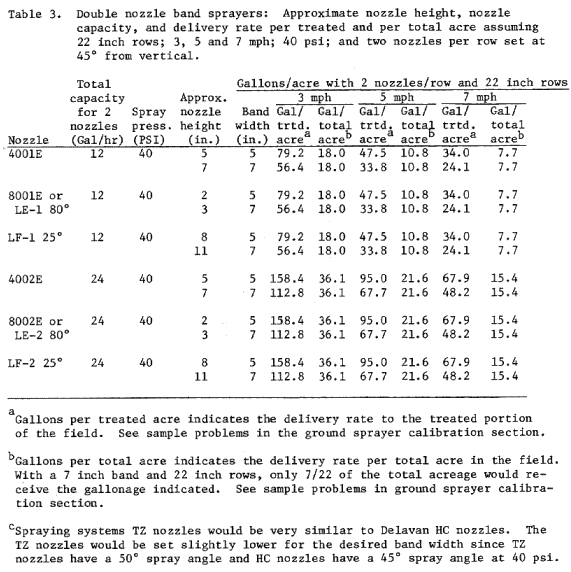
Table 2 and Table 3 do not contain all the possible nozzle sizes, spray pressures, band widths, row widths, and operating speeds. The following formulas and examples may be useful in obtaining answers for situations not covered in Table 2 and Table 3.
One formula to calculate the desired nozzle size for band application follows:
| 43,560 sq ft/A band width in feet |
= | linear feet of row in an acre |
| feet of row/A 5280 ft/mile |
= | miles of row/A |
| miles of row/A speed in mph |
= | hours to cover 1 acre |
| desired gallons per acre in the band hours to cover 1 acre |
= | desired nozzle capacity in gallons per hour. Divide by 60 to change to gallons per minute. |
Example:
| Assume | 5 4 40 20 |
inch band mph psi gpa in the band. |
| 43560 5/12 |
= | 104,544 ft/A |
| 104,544 5280 |
= | 19,8 miles/A |
| 19.8 4 mph |
= | 4.95 hrs/A |
| 20 gpa 4.95 |
= | 4 gph nozzle capacity |
Different Speeds: The delivery rate in gallons per acre is indirectly proportional to the speed that the sprayer travels.
The height of a nozzle for a desired band width can be calculated using the formula
| Tangent of the angle | = | side opposite side adjacent |
Example: How high should a 45° nozzle be set to obtain a 6 inch band width?
| Tangent | 22.5 | = | 3 inches (side opposite) unknown height (side adjacent) |
| .414 | = | 3 X |
|
| X | = | X = 7.2 inches. Nozzle height for a 6 inch band with a 45° nozzle. |
The tangent of angles can be found in tables of Trigometric Functions which are common in math books, in the Handbook of Chemistry and Physics, or is often on electronic calculators.
The height of a nozzle for a desired band width can also be determined by using a protractor. Using a protractor, draw an angle which equals the nozzle angle at the top of a sheet of paper. Use a ruler to determine the distance from the point of the angle to the point where the width between the sides of the angle equals the desired band width. The distance from the desired width to the point of the angle will equal the height of the nozzle above the target. Remember that nozzle angles are rated at 40 psi. A higher pressure will produce a wider angle and a lower pressure will produce a narrower angle.
Example: If a nozzle which delivers 4 gal/hr applies 25 gallons/A, how much would a nozzle that delivers 6 gal/hr apply?
| 4 gal/hr 6 gal/hr |
= | gal/A with 4 gal/hr nozzle gal/A with 6 gal/hr nozzle |
| 4 6 |
= | 25 X |
| 4X | = | 150 |
| x | = | 37.5 gal/A with 6 gal/hr nozzle |
Different spray pressures: The following formula will give an estimate of the change in delivery rate for a change in pressure.
| Rate in gal/A a high pressure | = |
sq. rt. high pressure |
x | rate at low pressure |
Example: If a sprayer delivers 40 gal/A at 60 psi, how much would be delivered at 30 psi?
| 40 gal/A | = | sq. rt. 60 30 |
= | low rate at pressure |
| 40 gal/A | = | sq. rt. 2 | = | low rate |
| 40 gal/A | = | 1.4 | = | low rate |
| 40 1.4 |
= | 28.6 gal/A at 30 psi | ||
Different band widths: The delivery rate in gallons per treated acre isin directly proportional to band width.
Example: If a sprayer delivers 20 gallons per treated acre in a 7 inch band, how much would be delivered in a 4 inch band?
| 7 inch band 4 inch band |
= | gal/A in 4 inch band gal/A in 7 inch band |
| 7 4 |
= | x 20 |
| 4X | = | 140 |
| x | = | 35 gallons per treated acre in a 4 inch band. |
Different speeds: The delivery rate in gallons per acre is indirectly proportional to the speed that the sprayer travels.
Example: If a sprayer delivers 30 gallons per acre at 7 mph, how much would be delivered at 10 mph?
| 7 mph 10 mph |
= | gal/A at 10 mph gal/A at 7 mph |
| 7 10 |
= | X 30 |
| 10X | = | 210 |
| X | = | 21 gal/A at 10 mph |
The data in Tables 2 and 3 should be confirmed by a field calibration. The data in the Table should be close enough to assist in nozzle selection and to confirm that the calculations from a field calibration are in the right range.Since variation in speedometers, variation in pressure gauges, and nozzle wear greatly affect the gallons per acre delivered by a sprayer, a sprayer cannot safely be calibrated by calculations. A field check on delivery rate must be made. The following section gives some possible methods for calibration.
The first step in any calibration procedure is to check the flow rate of all nozzles on the sprayer. Any nozzles that are abnormal in delivery rate should be cleaned or if cleaning does not correct the problem, replaced.
Three possible methods of calibrating a sprayer after checking nozzle delivery rate follow:
Method 1.
a) measure out 660 feet in the field to be sprayed.
b) fill spray tank up into the neck with water and mark the level of the water.
c) spray over the 660 feet at the sprayer pressure and speed to be used for the field.
d) record the volume necessary to refill the spray tank to the level marked in step e) calculate the amount of water applied per acre by using the following formula.
gallons per acre = gallons sprayed over the 660 ft x 66
width actually treated by sprayer in ftf) the width treated by the sprayer would be the boom width for a broadcast application. For banding, width would be band width in feet x number of bands and the gallonage would be gallons per treated acre.
Method 2.
a) measure out 660 feet in the field to be sprayed.
b) drive over the 660 feet with the sprayer but without spraying. Record the time required to travel the 660 feet at the speed which will be used for the field.
c) with a stationary sprayer, catch the volume of water delivered from 2 to 4 nozzles in the length of time it took to travel over the 660 feet. Use the sprayer pressure which will be used in the field.
d) record the volume caught from the nozzles and calculate how much would have been delivered from all nozzles using the following formula:
gallons applied over 660 feet = gallons caught X number of nozzles on sprayer
number of nozzles from which spray was caught.
e) calculate the amount of water applied per acre by using the following formula:
gallons per acre = gallons applied over 660 ft. x 66
width actually treated by the sprayer in ft.
f) the width treated by the sprayer would be the boom width for a broadcast application. For banding, width would be band width in feet x number of bands and the gallonage would be gallons per treated acre.
Method 3.
a) if some distance other than 660 feet would be easier to use, then methods 1 and 2 can be used with a different distance but the formula for calculating gallons per acre must be modified as follows:
gallons per acre = gallons sprayed in test run
width treated by the sprayer in ft.x
x43560 sq. ft. in an acre
length of test run in ft.
This method will give gallons per treated acre for a band sprayer.
b) at least 300 feet should be used for a test run.
- Calculations -
Method 1:
| Actual acres treated in 1/2 mile test run | = | 2640 ft/1/2 mile x 12 rows x 7/12 ft. band 43,560 sq ft/acre |
= | 0.424 acres |
| gallons per treated acre | = | 9 gal in test run .424 treated acres in test run |
= | 21.2 gal/treated acre |
Want to apply 6.15 pints per actual treated acre so every 21.2 gallons of spray solution should contain 6.15 pints of Betanex.
| Betanex per 150 gallons | = | 150 21.2 |
x | 6.15 | = | 43.5 pints of Betanex per 150 total gallons of spray solution. |
At 21.2 gal/treated acre, 150 gallons will treat 7.1 acres. Only 7/22 of the soil is being treated so the total field acres covered while treating 7.1 acres would be 7.1 x 22/7 = 22.3 total acres.
Method 2:
Another way to calculate the same problem would be to use the band rate and the total acres instead of the broadcast rate and the treated acres.
| total acres in 1/2 mile test run |
= | 2640 ft/1/2 mile x 12 rows x 22/12 ft/row 43,560 sq ft/acre |
= | 1.333 acres |
| gallons per total acre | = | 9 gal in test run 1.3 total acres in test run |
= | 6.9 gal/total acre |
Want to apply 2 pints per total acre (band rate) so every 6.9 gallons of spray solution should contain 2 pints of Betanex.
| Betanex per 150 gallons | = | 150 6.9 |
x | 2 | = | 43.5 pints of Betanex per 150 total gallons of spray solution. |
This is the same answer as derived from method 1. The 150 gallons will still cover 7.1 treated acres or 22.3 total acres.
Problem 2: A sprayer has a tank which will hold 250 gallons. Betanex is to be applied in a 5 inch band on 22 inch rows at seven miles per hour and 40psi. The desired delivery rate is 20 gallons per treated acre. What size nozzle should be used? How much water should be used by a 12 row band sprayer in a 1/2 mile test run? Assuming the actual test run uses the same amount of water as calculated, how much Betanex would be put in the 250 gallon tank for1 lb/A or 6.15 pints per acre broadcast rate.
- Calculations
Look in Table 2 and find that-at 7 mph and 40 psi that a nozzle with a delivery rate of 8 gallons/hour will apply 22.6 gallons per treated acre or 5.1 gallons per total acre with a 5 inch band and 22 inch rows at 7 mph. The 22.6 gal/A rate is close enough to the desired 20 gal/A.
Method 1:
| Acres actually treated in a 1/2 mile test run | = | 2640 ft/1/2 mile x 12 rows x 5/12 ft band 43,560 sq ft/acre |
= | 0.303 acres |
| Gallons expected to be used in 1/2 mile test run | = | 22.6 gal/treated acre x 0.303 | = | 1.33 acres |
Method 2:
| Total acres in a 1/2 mile test run | = | 2640 ft/1/2 mile x 12 rows x 22/12 ft/row 43,560 sq ft/acre |
= | 1.33 acres |
| Gallons expected to be used in 1/2 mile test run | = | 5.1 gal/total acre x 1.33 | = | 6.8 gal. |
Method 1:
| Betanex per 250 gallons | = | 250 gal/tank 22.6 gal/treated acre |
x | 6.15 pts/ treated acre | = | 68.0 pints/250 gal |
The band rate of Betanex or the amount to apply per total acre with 5 inch bands and 22 inch rows would be 6.15 pts/treated acre x 5/22 = 1.4 pints/total acre.
| Betanex per 250 gallons | = | 250 gal/tank 5.14 gal/total acre |
x | 1.4 pints/ total acre | = | 68.1 pints/ 250 gal. |
The same answer (within rounding error) was obtained with both methods.
1978 Sugarbeet Research and Education Board, Volume 9, pg. 48 -58