Gerald H. Smith
Consultant
Farm Management and Agricultural Research
West Fargo, North Dakota
These observations prompted further research, in 1973, to plant to stand the fastest growing variety with a precision planter to the proper depth at a slow speed. This, coupled with good management, soil preparation, pest control and cultivation, would allow a grower to harvest a high yield without thinning.
Money for the project came from the Red River Valley Sugarbeet Growers Association Research Fund. Cooperating growers were: Dale Stenerson, Halstad, Minnesota--Fred and Tim Eisenhardt, Kelso, North Dakota--Dick and Jim Hutton, Manvel, North Dakota. Each donated their time, land and extra effort to make the research project possible
Each four row plot was harvested separately with a commercial harvester and weighed to determine the yield per acre. Stand counts were taken at harvest time.
The second plot location was on the Fred Eisenhardt farm near Kelso, North Dakota. A twenty acre field was used for the plot consisting of half summer fallow on one end and half old ground on the other end. Prior to planting, a sixteen row Alloway incorporator was used to incorporate a combination of herbicides in a seven inch band. The combination consisted of 2 pounds RoNeet, .9 pound Eptam and 1.2 pounds Avadex in 36 gallons of water.
On April 30, a 16 row IH Cyclo planter was used to plant sugarbeet seed 7.5 inches apart in the treated 7 inch band 3 1/2 mph about 1 1/2 inches deep. Thirty-two rows of Bush Mono #3 size seed was planted on the north side of the plot followed by 32 rows of American Crystal Sugar #4 Hybrid A #4 size seed. Then, one side of the planter was filled with Bush Mono seed and the other with Great Western Hybrid A #1 size seed and another round made. The plot design resulted in 32 rows of Bush Mono starting on the north side of the field--32 rows of American Crystal Sugar #4 Hybrid A--8 rows of Bush Mono--16 rows of Great Western and 8 rows of Bush Mono.
During the growing season, the field was cultivated and cross harrowed. A mechanical weed puller was used to pull the weeds that protruded above the sugarbeet canopy.
Each plot was harvested separately, and five samples taken per load for sugar and impurity analysis.
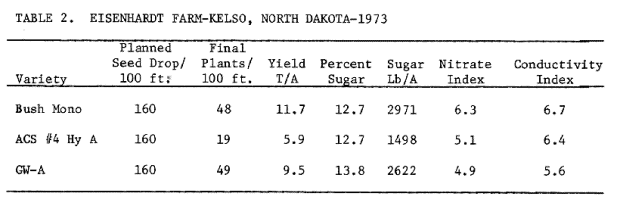
Table 2 contains the results of the plot. Plant populations were low which was primarily due to poor planter placement of seed in the soil and the method of seed cover. Further refinement in the planter to place the seed in the soil properly would alleviate a considerable amount of the problem. Despite the problems with the planter, the Bush Mono and Great Western varieties provided a much higher population than the American Crystal Sugar variety. The yields of each variety was a direct response of population. Higher populations yielded more tons and sugar per acre.
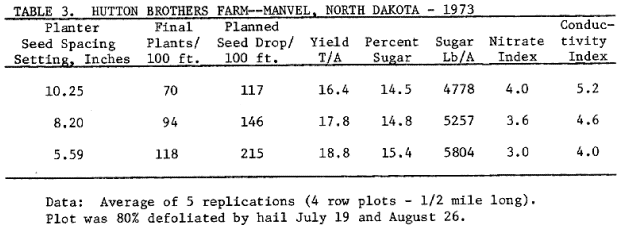
The third plot location was on the Hutton Brothers farm near Manvel, North Dakota. The plot was located on a summer fallow field treated with 2 pounds of Eptam incorporated with a cultivator. Planting occurred May 9 at 2 1/2 mph with an AMC planter containing Bush Mono #2 size seed. Seed was spaced at 5.59, 8.20, and 10.25 inches apart and 1 inch deep in four row plots one half mile long replicated five times. Dyfonate 10 G was applied in a band in front of the planter press wheel at the rate of 15 pounds per acre.
No weeding or thinning was done in the rows of the plot. The plot was cultivated twice during the growing season.
Each four row plot was harvested separately. Five samples were taken from each plot for analysis of sugar and impurities.
Table 3 contains the results of the plot. The highest yield of sugar came from the plots spaced at 5.59 inches. The population resulting from that spacing was also the highest.
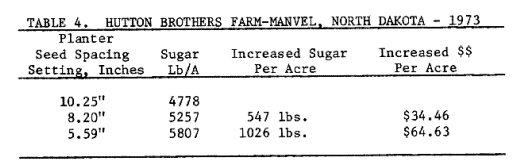
Table 4 illustrates the added return per acre for a grower with the closer spacing resulting from higher yields of sugar per acre. In this table, 6.3¢ per pound of sugar (grower share of sugar dollar) was used to calculate the return to a grower. The figures don't include the savings due from not thinning.
1973 Sugarbeet Research and Extension Reports. Volume 4, page 87 - 90.