PLANT POPULATIONS - PLANT SPACING - ROW WIDTH
Ron Torkelson
Sugarbeet Specialist
North Dakota State University - University of Minnesota
An additional 155,000 acres of sugarbeets could be planted in the Red River Valley and
Southern Minnesota production areas in 1974, providing new plant construction stays on
schedule. Several new growers and some established producers are considering growing beets
in row widths wider than the popular 22 inch width to convenience rotations which include
other wide-row crops. A limited amount of work has been done recently under present
cultural practices but work previous to that indicates a substantial loss of gross sugar
produced per acre. Considering the possibility of sugar loss due to increased impurities,
net or recoverable sugar may be even less.
The following summary statements on populations, plant spacings, and row widths are
based on both research data and opinion.
- Narrow spaced beets yield more sugar and less non-sugars (1894).
- A 16,000 beet population must yield 2\ times as many tons as a4 0,000 population and at
the same sucrose percent to have equal sugar yields. (Sugar % is often less, impurities
higher, and tonnage is seldom compensated for in low beet populations) (1921).
- "Ripening" or maturing is often much slower and even sometimes lacking in low
populations (1921).
- With few exceptions, in irrigated areas the highest net sugars produced per acre have
been obtained from populations in excess of 20,000 and in 20 or 22 inch rows.
- A square placement of beets has continuously produced the greatest beet yields since the
very first population investigation. The most recent work on equi-distant spacing (1969)
shows a 12.6 inch spacing (39,000 plants per acre) as the best population and special
arrangement.
- In a study of populations from 13,000 - 24,500 and in-row spacings of 16 to 22 inches,
the highest yield was from the highest population (Red River Valley, 1946).
- The highest yield was from 15 and 12 inch spacing in 18 inch rows (Red River Valley).
- In all trials, an 18 inch row width with 12 to 14 inch plant spacings produced the
highest yields (1938 to 1946).
- Increasing row width from 20 to 24 inches reduced sugar yields 400 pounds/acre (1946).
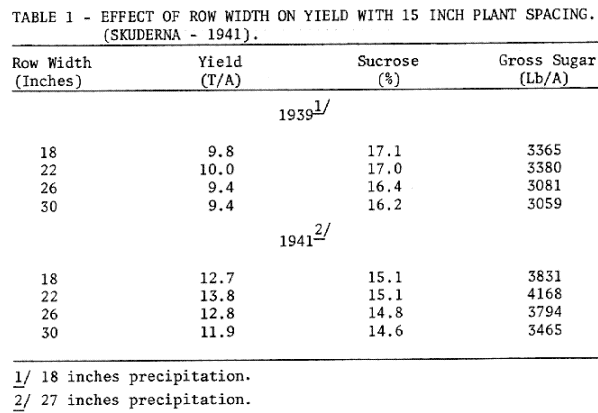
- Increasing the row width from 22 to 30 inches with plant spacing constant (15
inches) reduced sugar per acre 527 pounds (Table 1).
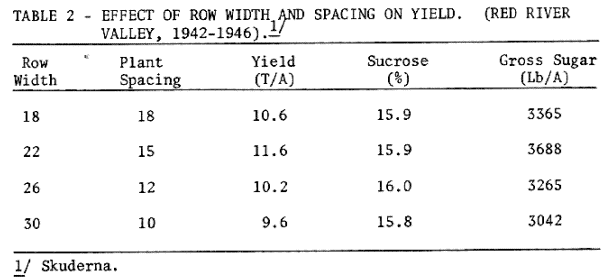
- Increasing the row width from 22 to 30 inches with population constant reduced
sugar per acre 646 pounds (Table 2).
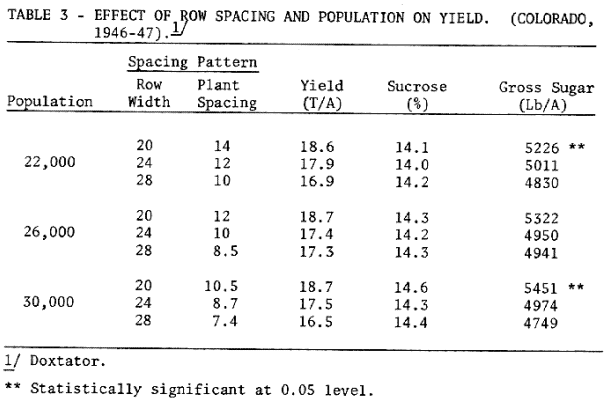
- Increasing the row width from 20 to 28 inches with populations constant at 22,000,
26,000, and 30,000 reduced sugars 396, 381,and 702 pounds/acre respectively (Table 3).
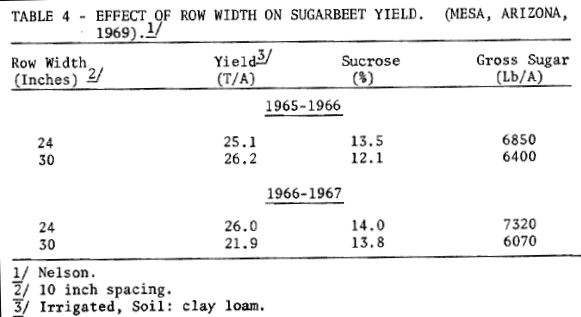
- Increasing the row width from 24 to 30 inches with plant spacing constant (10 inches)
reduced sugars 850 pounds/acre and with plant spacing constant (12 inches) reduced sugars
794 pounds/acre (Table 4).
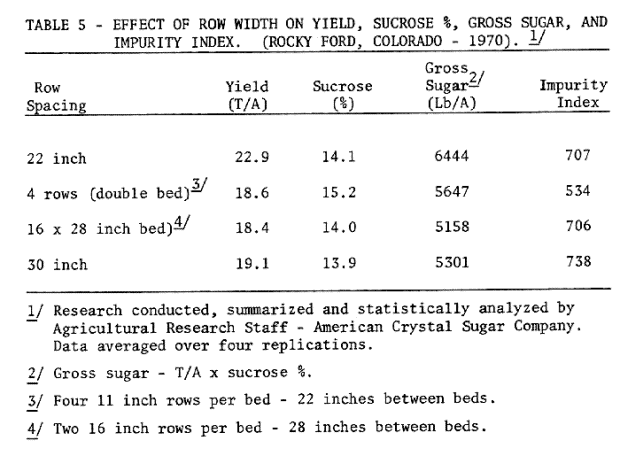
- Increasing the row width from 22 to 30 inches with the population constant reduced sugar
yield 1143 pounds/acre (Table 5).
- The significant loss of 400-500 pounds of sugar per acre could mean approximately a
$32.00 to $40.00 loss per acre. This could mean a $5,760 to $7,200 loss per year on a 180
acre contract and the amount lost over a five year period would more than cover the
initial cost of additional equipment needed for a crop with a narrow row width that
will be new to a farmers operation.
- Most equipment needed for narrow or wide row beets (other than equipment used in
land preparation) is specific and purchase is required regardless of crops in present
rotation. Exception is additional tractor and possibly cultivator.
Population
(Plants/A) |
Row Width
(Inches) |
Plant Spacing
(Inches) |
20,909
23,764
25,000
28,576 |
22
22
22
22 |
30
30
30
30 |
13.6
12.0
11.4
10.0
|
10.0
8.8
8.4
7.3 |
- A good population of 25,000 beets or more per acre will produce more tons, will have a
higher sucrose percent, will have fewer impurities, and will more efficiently utilize
plant available soil-nitrate nitrogen and other essential nutrients.
- Getting good beet populations is difficult. Growers, particularly in the Red River
Valley, are troubled with problems associated with achieving adequate and uniform plant
populations, both very necessary in producing maximum yields of good quality sugar. To
improve sugarbeet stands it is necessary, after assuring adequate soil nutrient levels, to
conserve sufficient seed zone soil moisture to improve more complete and uniform
germination, to reduce the amount of soil crusting to increase percent emergence, and to
reduce incidence of early season seedling damage and mortality from wind and wind erosion.
Many acres of beets are reseeded annually due to one or more of the problems associated
with getting good stands, or even more often, growers must be satisfied with less than
desirable populations. It is anticipated that similar problems may well be encountered in
the Renville Co-op area and increasing the row width increases the risk of poor stand
establishment since more beets per 100 feet of row are required to maintain a satisfactory
and uniform population.
The problems associated with stand establishment stems from the fact that the seed is very
small in size, it is planted relatively shallow (3/4 inch to 1\ inch deep) and it must be
planted at a uniform depth which requires a level, firm seedbed free of large clods. The
seed is often planted in a dry soil that requires 0.3 to 0.5 inch of precipitation for
uniform germination, it produces a very weak seedling that needs assurance that it will be
able to make it through the soil surface (which can become crusty), and which needs
protection from wind, blowing soil, weeds, insects, and disease during early seedling
growth.
- A greater potential for incidence of disease exists when beets are grown at high
populations or in narrow row widths. The probability of Cercospora Leaf Spot is greater in
the southern end of the Red River Valley and could become a serious problem in southern
Minnesota. (Growing Cercospora resistant varieties is the best preventative measure).
- There is some question as to whether or not the beet root system effectively utilizes
soil water and nutrients from a large enough soil volume when in 22 inch rows. It is
therefore highly questionable whether this would be accomplished under a wider row spacing
and it is very important, particularly the efficient use of plant available water under
dryland conditions, if maximum yields are to be achieved.
- Leaf Area indices will quite possibly be reduced when going to wider rows, particularly
if a desired population cannot be maintained. The photosynthetic product, namely sugar,
depends on canopies with optimum Leaf Areas.
- Unless beet canopies completely "close the row", evaporation from the soil
surface will increase and the amount of soil water available to the plant for important
respiratory processes will decrease.
- Unless beet canopies completely "close the row", weed control becomes more
difficult. Data shows that a healthy, mature beet can effectively compete with weeds in a
circle 2 feet in diameter. Late emerging weeds between the rows must be cultivated or
controlled with an additional herbicide application. If beets are far enough along, they
can be physically damaged by equipment during cultivation rendering them more susceptible
to disease and reducing important Leaf Areas.
- Weed Control is much more difficult in poor populations due to lack of competition and
the probability of getting poor stands in wide row spacings is much greater than with
narrow rows.
- All equipment presently being used in the Red River Valley and it is anticipated the
majority of the equipment that will be used in southern Minnesota will be of 22-inch row
design. Those growing beets in 22-inch rows will find a much greater selection when
trading or buying equipment and those needing to borrow, beg or steal in a time of
emergency will find it more convenient.
- Tractor traction (tire size) is not the limiting factor in inability to harvest beets
during wet weather if a dual tire system is used.
1973 Sugarbeet Research and Extension Reports. Volume 4, page 73 - 78.
Questions/Comments