Ron Torkelson - Sugarbeet Specialist
North Dakota State University - University of Minnesota
Fargo, North Dakota
Sugarbeet growers in the Red River Valley of North Dakota and Minnesota experienced a very successful 1973. A total of 3,243,111 tons were harvested from a total of 200,633 planted acres for an average yield of 16.17 tons per acre -the largest in history. The average sugar content, however, was 14.32 percent- a very low figure due primarily to untimely late season precipitation.
It was also the first year that growers in the Valley were paid on an individual sugar basis instead of the historical belt-line system. Growers beets were sampled individually at the piling and receiving stations and trucked to the central tare and sugar laboratory at East Grand Forks where they were analyzed for tare, sucrose percent, nitrates, and conductivity. (Some of these analyses and data are discussed in other sections of this publication). In looking at tare laboratory reports, there is considerable variability in the nitrate, conductivity, and sucrose data that, with some certainty, indicates there were several beet fields that had access to improper amounts of nitrate-nitrogen during the growing season. Everyone must do the best possible job in managing soil and fertilizer nitrogen to assure new plants and new growers in an expanding industry of good quality sugar.
Three new sugar processing plants are presently under construction - two in the Red River Valley and one in Southern Minnesota. It is planned that these three plants will be in operation next year and they have a combined contract acreage of approximately 155,000 acres that could be planted in the spring of 1974. These additional 155,000 acres combined with the present 202,000 Red River Valley acres will represent approximately 25 percent of the total United States beet acreage.
Growing many of these additional acres are farmers that will be growing sugarbeets for the first time. It is also anticipated that these new growers will be paid on an individual sugar basis in the near future if not in 1974. Consistently producing a good crop of beets is difficult but producing a good crop of sugar is even more difficult. To "grow" a good yield of recoverable sugar per acre the beets must be of good quality. A good quality beet is high in percent sucrose, low in the impurities Na, K, and amino-N and would read low on the nitrate and conductance scale.
Many factors have a direct influence on beet quality and some of them are under a growers control. Of those factors under his control, the application of fertilizer, particularly nitrogen, may well influence quality more than any other factor. (Nitrogen and Beet Quality in discussed in the 1972 Sugarbeet Research and Extension Reports under Sugarbeet Production - 1972). A good soil testing - fertilizer recommendation program is the best, if not the only method for determining proper nitrogen requirements for a good quality beet crop.
The following pages constitutes the new and revised circular S-F 4, "Fertilizing Sugarbeets". Fertilizer recommendations according to the new circular are based on yield goals. It includes a discussion of new soil test ratings, yield goal determinations, fertilizer recommendations, and fertilizer application.
S-F 4
| D. F. Wagner Extension Soils Specialist |
W. C. Dahnke Soil Testing and Dept. of Soils |
J. T. Moraghan Dept. of Soils |
Ron Torkelson Extension Sugarbeet Specialist |
Fertilizer needs for your sugarbeet crop are determined by carefully relating the current fertility level of the soil and the expected yields of sugar and roots to the nutrient needs of sugarbeets.
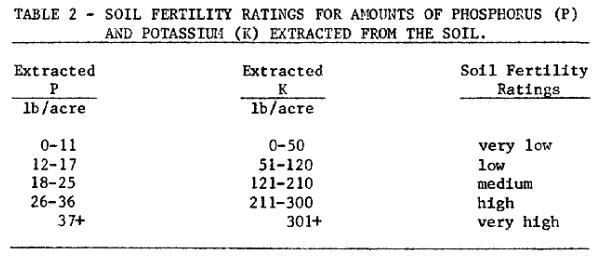
Phosphorus and Potassium: The assigned soil fertility ratings for phosphorus and potassium are shown in Table 2. These ratings are based on the soil test which evaluates the fertility levels of P and K at the time of sampling. A1though the phosphorus and potassium recurred for the crop also increases as yields increase, test ratings for these nutrients are not changed with increasing goals.
The amount of each plant nutrient required by a crop is dependent on the total production of that crop. To make realistic fertilizer recommendations, it is necessary to consider the yield goals as well as to know the current fertility level of the soil.
When setting a sugarbeet yield goal for which fertilizer recommendations are requested, it is important to remember that sugar is the product sought and that over-fertilization, particularly with nitrogen, can result in poor quality beets 9 and hence reduced net returns. Thus, in setting yield goals, improvement of management factors such as uniform and adequate plant populations, weed control, timeliness of operations (especially early planting), disease and insect control, etc. must all be improved along with increased fertilizer use.Also other yield influencing factors, such as the expected or potential climatic conditions, stored soil moisture levels and the production capacity of the soil must also be considered in estimating yield goals.
The best crop, from both a total yield and quality standpoint, that has been produced on a particular field in the past, is a good starting point to considering estimating the yield goal. Then adjustments can be made for changes in management practices and skills, and potential moisture conditions. Usually the yield goal should be within 3 tons of the base yield being used.
Circular S-F 1 may be useful in helping set yield goals.
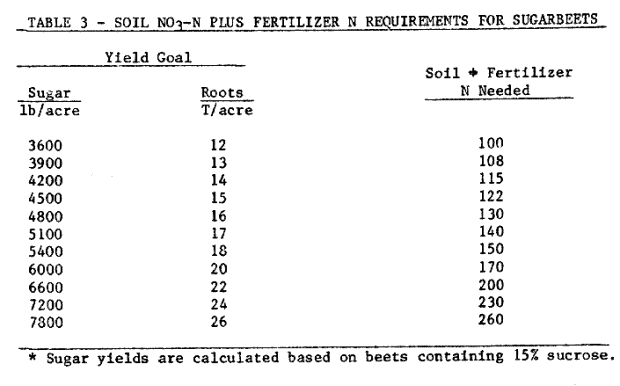
To determine fertilizer nitrogen requirements, find the amount of soil plus fertilizer N needed for your yield goal in Table 3 and subtract the soil test level of NO3-N.
As an example:
Your NDSU soil test shows that there are 50 pounds of NO3-N present in the soil to 2 feet. Your yield goal is 16 tons per acre (4800 lb sugar/acre). The amount of fertilizer that should be applied would be 80 pounds actual nitrogen (N) per acre. (This is the difference between 130 pounds taken from Table 3 and 50 pounds from the soil test).
For production of high quality sugarbeets, nitrogen needs must be managed so that adequate nitrogen is available for early season growth, but approaches deficiency levels approximately 6 weeks before harvest. Thus if the growing season is shortened by late planting, nitrogen fertilizer rates should also be reduced. A general guide is to reduce recommended fertilizer rates by 10 pounds of N for each week planting is delayed after May 20.
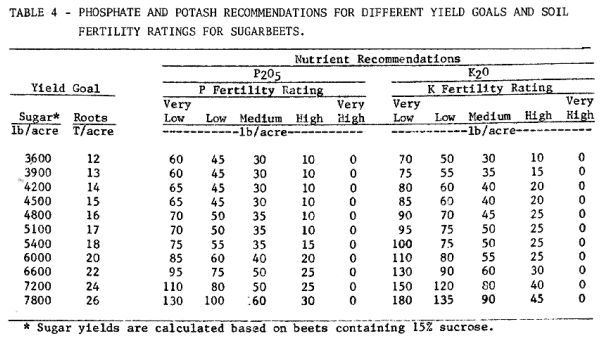
Phosphate and Potash: Because of the nature of phosphate and potash soil chemistry, the simple method of subtracting the soil test level from the amount needed for the crop does not work. The amounts of phosphate (P2O5)and potash (K2O) needed to meet different yield goals are given in Table 4.
As an example:
If the yield goal for sugarbeets is 16 tons (4800 lb sugar per acre) and the phosphorus fertility level is medium (M) and the potassium fertility level is very high (VH) the fertilizer recommendation would be 35 lb/acre of P2O5 and no K2O.
Micronutrients: During the past few years there have been reports of responses to zinc (Zn) on sugarbeets. However, research has not shown a positive need for this nutrient in the major sugarbeet growing areas of the state and surrounding areas.
Before using Zn it is suggested that a soil test for this nutrient be obtained. If results of such a test shows a soil fertility level of less than 0.5 ppm Zn, applications of 10 to 15 pounds per acre actual Zn as zinc sulfate or 2 to 3 pounds per acre actual Zn in a chelate form is suggested on a trial basis.
Responses to other micronutrients have not been reported or demonstrated. If questions arise about possible needs for manganese, copper or iron, a soil test for these nutrients should be obtained.
Phosphate fertilizers have a low salt index and can be safely placed in contact with the seed. Then phosphate is banded with or near the seed, its availability and efficiency is usually improved, especially for early season growth, therefore, it is strongly recommended that at least 10 to 20 pounds per acre of P2O5 be applied with or near the seed at planting time. Use of starter phosphate fertilizer is especially important on soils testing very low and low in phosphorus.
All NDSU phosphorus recommendations for sugarbeets assume that the phosphorus will be applied in bands with the planter. If all phosphorus fertilizer is to be broadcast, double the recommended rate for very low, low and medium testing soils and apply it ahead of plowing or the deepest tillage operation. On soils testing high and very high, shallow incorporation is adequate.
In some areas it may not be possible to obtain straight phosphate materials in sufficient quantities to meet your phosphate fertilizer needs. In this case, monoammonium phosphate (11-48-0) or diammonium phosphate (18-46-0) may be used as a starter fertilizer at rates up to 50 pounds of material per acre. The -small amount of germination damage that may result from the seed contact with the nitrogen will generally be more than offset by the improved yields resulting from the banded application of the phosphorus and the reduced fertilizer cost when compared to broadcasting phosphorus.
If part of the P2O5 recommendation is to be broadcast with the remainder going on with the planter, increase the broadcast portion 1.5 times and apply the phosphorus ahead of the deepest tillage operation to place it in a more favorable position in the soil and to help prevent possible losses through runoff and/or eroding soil.
An example of adjusting P2O5 recommendation when using a split application:
| Recommended rate Will apply with planter Remaining portion Broadcast (30 x 1.5) |
50 lb/A P2O5 20 lb/A P2O5 30 lb/AP2O5 45 lb/A P2O5 |
total to be applied 65 lb/A P2O5 (1401b/A of 0-46-0, for example)
Fall applications of nitrogen are not recommended on coarse textured soils, soils with a high water table, or on soils subject to water ponding in the spring. On such soils, apply nitrogen as near to planting time as possible. Although side dressing nitrogen on sugarbeets is generally not recommended there may be times when it is not possible or practical to apply nitrogen before planting. Side dressing should be done before the sugarbeets have reached the 4 or 6 true leaf stage. When side dressing sugarbeets, the recommended rate should be reduced 10 pounds of nitrogen for each week beyond May 20 that the fertilizer is being applied.
1973 Sugarbeet Research and Extension Reports. Volume 4, page 67 - 72.