Dr. John Moraghan
Professor of Soils
North Dakota State University
Fargo, North Dakota
This year, 1973, was the beginning of the sugar-per-acre era for those of us associated with the sugarbeet industry in the Red River Valley. Farmers, fieldmen and researchers all started thinking to a greater extent in terms of sugar rather than root yields; this of course resulted from the1973 payments being based largely on individual sugar yields.
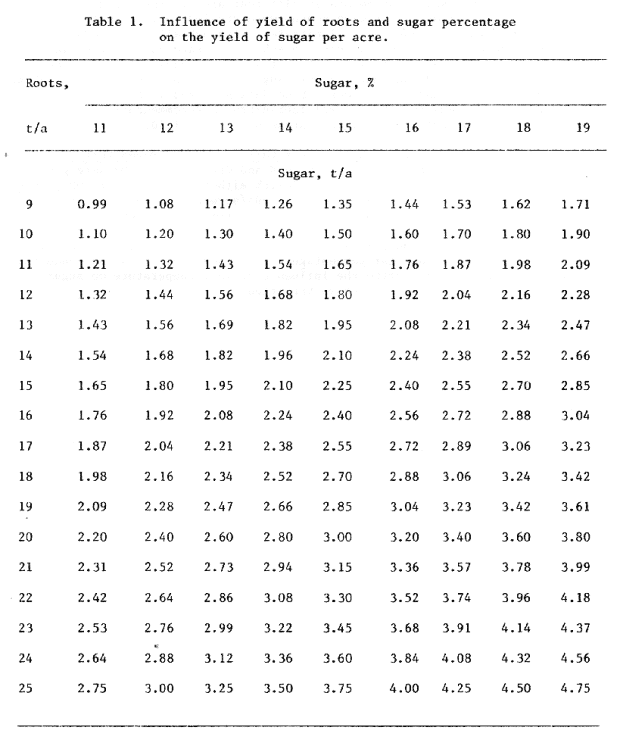
As shown in Table 1 sugar yields for a given root yield can vary greatly. Yield or beets of 20 and 25 tons per acre containing approximately 17 and 14% sugar respectively will result in sugar yields of 3.5 tons per acre. Such a sugar yield is unusual under field conditionsl, but research has indicated that it can be set as a goal for efficient producers in the Valley. Its attainment is dependent on good management and a combination of fortuitous circumstances. These factors include:
(a) Early planting
(b) A stand of 100 to 120 evenly-spaced plants per 100 feet of row (depth of planting, seedbed preparation, soil moisture and crusting effect stand).
(c) A good coverage of leaf foliage by June 30 to July 7 (leaf area index greater than 3.5).
(d) Good weed control.
(e) Careful selection of variety.
(f) Adequate fertilization based on soil testing.
(g) Adequate precipitation combined with adequate top and subsoil moisture during the growing season.
(h) No disease or insect problems (the grower has some control over this through choice of variety, insecticide, rotation and foliar spraying).
(i) Average or above average temperature during September.
The excellent 1973 commercial yields can be largely explained in terms of the above factors; early planting, large evenly-spaced stands, adequate fertility, effective weed control and lack of extensive drought were all important.
Factors which influence sugar accumulation and which the grower has some control over includes soil inorganic nitrogen level, fertilizer nitrogen rates, stand, date of harvesting and variety.
If I were asked what factor apart from moisture is usually limiting production to the greatest extent in the Valley, I would suggest that it was stand.
1 The yield of 7,544 pounds of sugar (3.78 tons) per acre achieved by the Nelson Brothers of rural Clay County for the highest production in the Moorhead District is worthy of particular mention.
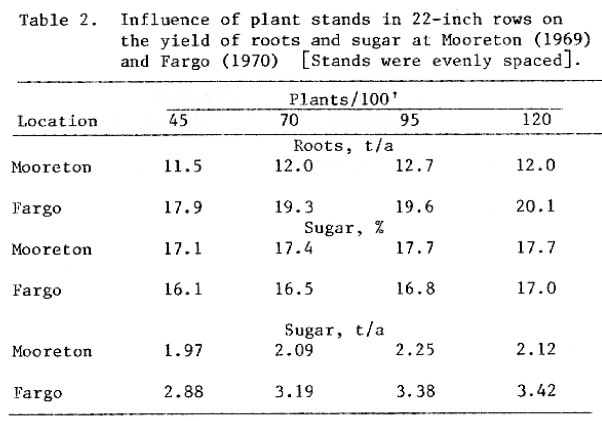
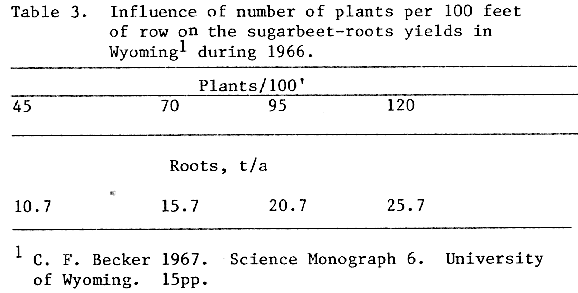
This perhaps may be a surprising statement in view of the modest influence of stand on root and sugar yields at Mooreton and Fargo (Table 2). Precipitation was sparse in both years and a smaller reserve of soil moisture restricted yields at the Mooreton site. When stands in farmer fields are correlated with root yields the effect of stand appears to be much more dramatic. I have taken the liberty of expressing some stand-yield data obtained from some Wyoming farm fields in a form similar to our North Dakota data and these are given in Table 3. The following conclusions are drawn from the overall data:
(a) Higher populations increase the yields of roots and sugar as well as percentage sugar.
(b) Yield increases due to increases in stand are greater under farm conditions. Two factors may be responsible for this.
(1) Farm plant spacings are not even and extensive yield-limiting gaps, particularly in low-stand fields, occur within the rows.
(2) Efficient producers may be more likely to have larger, more evenly spaced stands.
At the present time early planting and attention to seedbed preparation are the best practical tools to insure satisfactory stands. It has recently been claimed that mulching the seeding lines with soil aggregating agents such as polyacrylamides has been economic in France and Belgium. In experimental plots in Idaho application of agricultural-grade phosphoric acid diluted to12-14% in three-inch bands on the seeded row directly behind the planter has decreased crusting and increased seedling survival. The phosphorus content of the seedlings was also increased.
A number of field experiments involving plant nutrition were conducted in the Red River Valley during 1973. A preliminary evaluation of the data is as follows:
(a) Comparison of pre-plant ammonium nitrate with foliar applied urea.
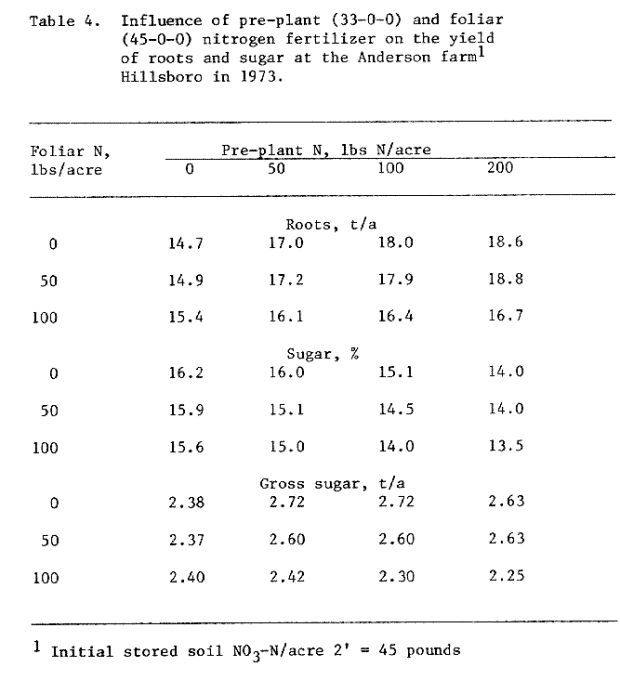
In this experiment conducted at Hillsboro 0, 50, 100 and 200 pounds N per acre (as ammonium nitrate) were applied pre-plant. On July 19 when the root yields were less than 3 tons per acre 0, 50 and 100 pounds urea-N per acre were applied as foliar sprays. The petiole nitrate-N concentration on July 12 was approximately 1,000 ppm in the check plots. Some leaf damage from the foliar N applications occurred, but there was little evidence that any beneficial effects accrued (Table 4). If post-plant nitrogen fertilizer is to be beneficial earlier application would appear to be needed. At the present time preplant application of nitrogen fertilizer is strongly recommended. Of interest was the finding that the nitrogen required for the optimal yield of roots was more than that required for optimal gross sugar production.
(b) Utilization of subsoil nitrate by sugarbeets.
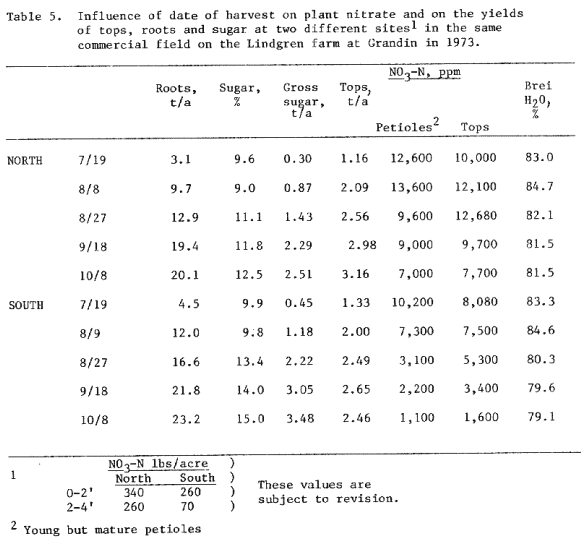
The soil-nitrate test involves sampling the soil to a depth of 2 feet and determining the nitrate content. Little information is available concerning the availability to sugarbeets of nitrate located below 2 feet, but past research in the Valley has suggested that it could be of importance. During 1973 a farm field was located at Grandin which contained approximately 260 and 70 pounds nitrate-N per acre in the 2 to 4 foot-depth increments in different areas. The yields of tops, roots and sugar during the growing season were studied together with changes in soil moisture and plant and soil nitrate. Although all data are not yet available there are indications that the subsoil nitrate had a marked influence on sugar accumulation (Table 5). At this time it is considered that sampling to a depth of 2 feet is adequate on most sugarbeet fields, but deeper sampling may occasionally be more efficacous. Some data gathered in this experiment indicate the problems in making fertilizer-nitrogen recommendation due to differences in soil nitrate on contiguous areas of a farm field.
(c) Response of high- and low sugar varieties to nitrogen fertilizers.
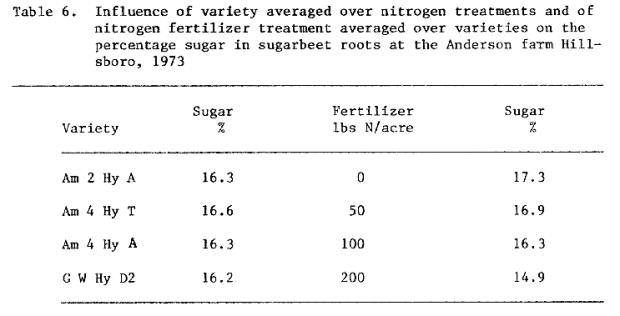
Am 2 hybrid B, Am 4 hybrid T, Am 4 hybrid A and Great Western D2 were grown on a nitrogen-deficient soil and treated with either 0, 50, 100 or 200 pounds of N applied pre-plant (soil NO3-N = 45 pounds/acre 2). Some Eptam damage occurred at this site. The most interesting feature of the data from this trial was the relatively small effect of variety on sugar percentage under the given experimental conditions (Table 6). In contrast, nitrogen fertilizer markedly influenced sugar percentage. Additional work is being conducted in the greenhouse to determine the influence of soil temperature on sugar percentage and accumulation by these varieties.
1973 Sugarbeet Research and Extension Reports. Volume 4, page 59 - 66.